We often reach for the tarot wanting a clear answer to a specific question.
For instance, you might recognise asking one of these questions yourself:
Should I break up with my lover?
Are they coming back?
Should I leave my job?
What’s the right decision?
There’s nothing wrong with asking any of the above. Questions like these naturally arise from pain, confusion, or those moments in life when something meaningful is lost or feels like it’s slipping away. Wanting certainty in the face of this doesn’t make you naïve, it makes you human.
But there is no certainty in an existence where the only true constant is change.
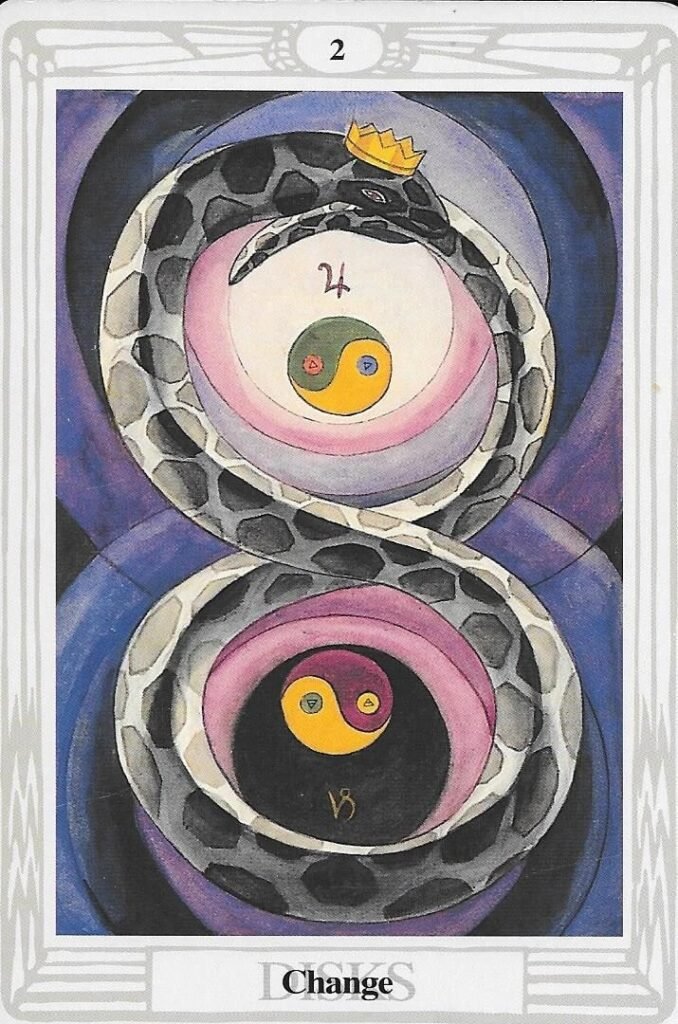
The Two of Disks, for example, speaks to the ongoing, infinite nature of change.
The ouroboros, the snake eating its own tail, reminds us that transformation is at the root of creation – in itself, the endless cycle of death and rebirth. On a cellular level, we depend on constant change just to stay alive. It’s stasis, not movement, that leads to decay. At the same time, it’s important to recognise that endings are often painful, and that change takes time to make sense of.
Or, as my mentor Avril Price has been known to say:
“One door closes, another opens. But the hallways are a bitch.”
What sits inside those hallways is often fear of the unknown, of loss, and ultimately of Death. In Western culture in particular, we tend to be deeply uncomfortable with endings. We rush toward resolution, toward closure, toward “feeling better.” Change is framed as something to embrace or get through, rather than something that might need to be mourned.
And grief isn’t only about death. It shows up in breakups, career shifts, identity changes, illness, estrangement, and the moments when a version of your life is no longer available. Even when change is necessary, even when it’s chosen, it can still hurt.
More contemporary understandings of grief are that it is something that is more relational and ongoing. it’s not a problem to solve or a feeling to get over. It’s a process of learning how to live with change. We don’t let go, as much as we begin to make room for what has altered, carrying its memory or meaning forward in a different form.
This is where tarot can be most honest. Not by bypassing pain with reassurance, but by acknowledging that change costs something. That uncertainty can’t always be resolved immediately. And that clarity often arrives not as a clean answer, but as a growing capacity to stay present with what is actually happening.
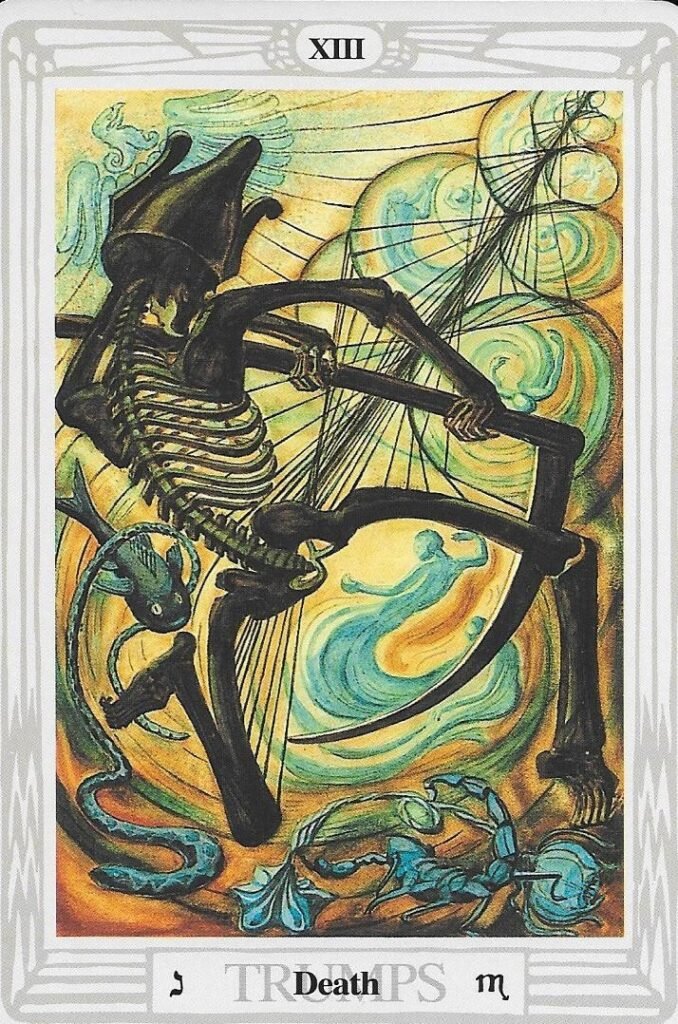
The Death card speaks directly to this territory.
Despite its reputation, it isn’t a card of catastrophe or finality. It’s a card about the necessity of endings and what becomes possible when we stop resisting them. It asks us to consider how we are meeting an ending and what we are carrying with us as we cross the threshold of change.
“The Universe is Change: every Change is the effect of an Act of Love; all Acts of Love contain Pure Joy. Die daily! Death is the apex of one curve of the snake Life: behold all opposites as necessary complements, and rejoice!” ~ Aleister Crowley
The snake appears again here, as it does in the Two of Disks. Its ability to shed its skin in order to grow reminds us that transformation requires release. And not just as a single act, but as an ongoing process. The eagle above the figures’ helmet points toward the liberation that comes from loosening our grip on what has become stagnant or constricting.
Or, as Terence McKenna puts it, magic is done by “hurling yourself into the abyss and discovering it’s a feather bed.”
The abyss, in this sense, is the dark night of the soul. Something many of us encounter alongside painful change. That strange, in-between passage as we move from the known into the unknown, without any guarantee of what comes next.
When people come to tarot at moments like this, they’re often not really asking for prediction.
They’re asking how to be with what’s happening. How to orient themselves inside uncertainty. How to listen for something steady when the ground feels like it’s moving.
I see tarot less as a tool for answers and more as a tool for conversation with our higher self – or deep innate wisdom if you prefer to put it that way. In other words, it serves us to recognise that we are each the highest authority on our own lives. We just might not always have space, language, or tools to access it.
In that sense, I don’t believe the tarot reader is the authority in the room. And I’m wary of practices that place too much power, or too much responsibility, on the reader’s interpretation.
I don’t want anyone leaving a session with me feeling that their future has been decided for them.
For me, ethics live in awareness: of the unspoken power imbalances that can arise in the dynamic between reader and sitter; of the desire for certainty when what’s actually being asked for is honesty, care, or permission to trust oneself. They also live in being clear about what I can and can’t offer or intuit, and in paying attention to dependency and projection when they appear.
That’s also why I hold clear boundaries around what I will and won’t read on. Not because those topics are taboo, but because they fall outside the kind of work I’m committed to doing. I don’t diagnose illness. I don’t offer medical, legal, or psychological advice. I don’t engage with narratives about possession, dark magic, or forces acting on someone without their agency. And I won’t read for people under the influence of intoxicants, or for minors without appropriate support.
None of this is about claiming moral superiority, or setting a universal standard for tarot practice. Ethics aren’t fixed, and what feels right to one practitioner won’t feel right to another. This is simply the framework I work within. It’s shaped by experience, reflection, and a belief that good spiritual work should leave people more connected to themselves, not less.
Ultimately, I trust that you are your own wise guide.
Tarot can help shine a light, open a conversation, or reflect something back to you, but the wisdom doesn’t belong to the cards, and it doesn’t belong to me. It belongs to you.
And if a reading helps you hear that more clearly, then it’s doing its job.